Skip to content

Stockholm, Sweden

Rickard Sörlin

AI Product Management & Offer Strategy — Digital Platforms

Nordic Technical Support Expert · Developing toward Product & Offer Management

I start with the customer's problem, not the solution. For 20+ years at Schneider Electric I have worked where customer needs, technology, delivery and business value meet. Today I connect Nordic customer needs with platform quality and R&D prioritisation — and I am building toward Product and Offer Management.

  • Customer discovery & solution direction — Led technical discovery and shaped, presented and delivered digital building solutions for healthcare, pharmaceutical and other mission-critical customers — aligning needs, feasibility and trade-offs across engineering, sales and management.
  • Product feedback, prioritisation & lifecycle — Turn recurring field issues into structured product feedback and enhancement proposals with R&D for EcoStruxure Building Operation and its edge IoT ecosystem — prioritised by customer impact, technical risk and business relevance.
  • Applied AI & Computer Science — B.Sc. in Computer Science (Intelligent Systems), Mälardalen University — applied work in RAG, forecasting and agentic AI.
  • Postgraduate AI Studies — University studies in Natural Language Processing, Predictive Data Analytics, Computer Vision and Autonomous Systems at Umeå, Linköping and Mälardalen.
  • Postgraduate Industrial Economics & Management — Blekinge Institute of Technology — Product Management, Requirements, Strategy & Business Models, Innovation, Agile Project Management, Portfolio Strategy and Leadership.
  1. Industrial Systems
  2. Digital Platforms
  3. Product
  4. Applied AI
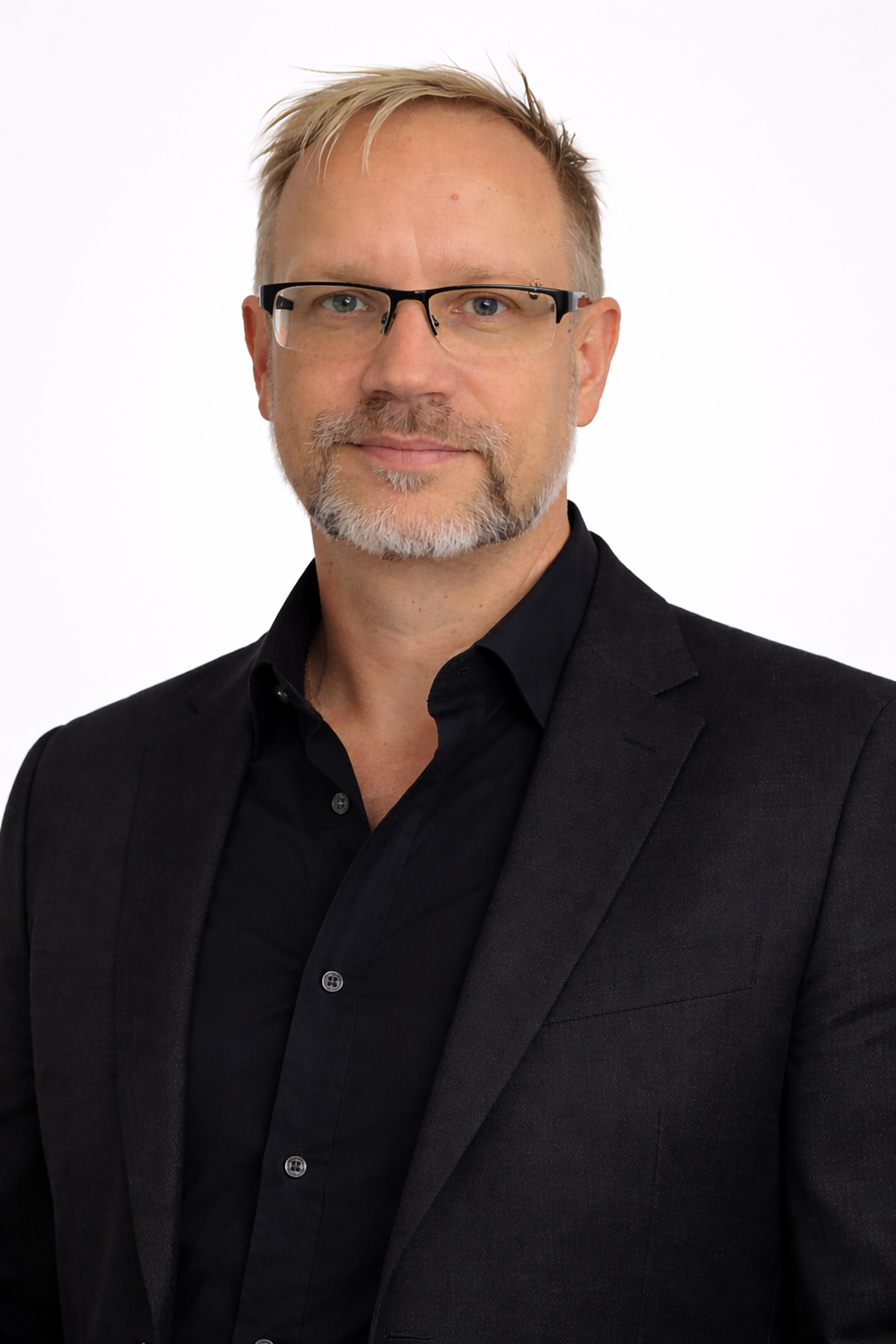
Portrait of Rickard Sörlin

The journey

From control cabinets to AI products

From customers' control cabinets to AI-enabled products — one continuous story, with the customer at the centre of every chapter.

I began as a Project Engineer, working with customers on discovery — understanding the job to be done and what would break if we got it wrong. From requirements to delivery of digital solutions for building operation and energy optimisation, I stood next to the customer at go-live and learned the lesson everything else builds on: a product's real value is decided by the people who use it every day, not by the requirements that define it. As Sweden's national technical expert for a digital building platform and its edge controllers, I saw the faults that kept coming back. I owned a reusable capability that turned HVAC data into actionable insight, and with Product Owners and R&D turned recurring field issues into structured product feedback and enhancement proposals, prioritised critical defects and validated releases.

The next step moved me closer to the business. As Senior Technical Advisor, I led discovery for healthcare, pharmaceutical, data-centre and other mission-critical customers. I presented solution proposals, weighed customer value, feasibility, lifecycle risk and cost, and held end-to-end technical responsibility — making sure what we proposed was viable to sell, build and support. I also represented Schneider Electric at KTH Live-In Lab, an open innovation platform, as its EcoStruxure Building Operation contact.

Curiosity about what AI could realistically make possible brought me back to study: a B.Sc. in Computer Science (Intelligent Systems) at Mälardalen University from 2023, then advanced studies in machine learning, natural language processing, predictive data analytics, computer vision and autonomous systems.

To move from technology toward product, strategy and business, I specialised in Industrial Economics and Management at Blekinge Institute of Technology. My career has always been about creating value through products and digital solutions — now I wanted to get closer to the customer and shape solutions from real problems. Product management, requirements, innovation, strategy, business models and leadership gave me the tools.

Talking SCADA became the case where these perspectives met: letting a building explain in plain language where energy is wasted, why, and what to investigate next — with human judgement kept central.

After my studies, I stepped into an intermediate role as Nordic Technical Support Expert — owning strategic customers, mentoring Level 2 advanced support engineers, and turning recurring Nordic field cases into structured product feedback and enhancement proposals with R&D for EcoStruxure Building Operation and its edge controllers. I continue to develop toward Product and Offer Management.

That is what I bring to product management and offer strategy: I start with the customer's problem, not the solution. I understand both sides — the people who run complex digital platforms and connected systems, and the teams who build, deliver and support them. I have hands-on experience with applied AI — RAG, forecasting, agentic systems — and know what it can realistically support and where human judgement must stay central. I align engineering, R&D, sales and support around a shared direction. I listen before defining, validate before committing, make trade-offs visible, and weigh customer value and business-model fit alongside feasibility — so a direction is not only desirable to build, but viable to offer and sustain.

Customer & Business

  • Customer Discovery
  • Jobs to Be Done
  • Problem Validation
  • Business Value

Product & Strategy

  • Product Vision
  • Requirements / PRD
  • Prioritisation
  • Product Strategy

Lifecycle & Collaboration

  • Product Feedback
  • Roadmap Input
  • Release Readiness
  • Stakeholder Alignment

Technology & Human-Centred AI

  • Technical Feasibility
  • Architecture
  • Applied AI
  • User Validation
  1. Now · Direction

    Product & AI Direction

    20+ years of customer and platform experience, combined with product discovery, strategy and applied AI — to shape products that are useful, feasible and viable.

    • AI Product Manager
    • Product Manager
    • Product Owner
    • Offer Manager
  2. ProfessionalDevelopment
  3. 2026–Present· Professional

    Nordic Technical Support Expert

    Building Management Systems

    Schneider Electric

    Nordic Customer Insight · Platform Quality · Prioritisation

    Nordic responsibility connecting complex customer and partner needs with platform quality, R&D collaboration and prioritisation for EcoStruxure Building Operation and its edge-controller ecosystem — in an international, English-speaking environment.

    • Own the largest, most strategic VIP customers — technical depth, clear communication and an understanding of their operations.
    • Turn recurring Nordic field cases into structured product feedback and enhancement proposals for EcoStruxure Building Operation and its edge IoT ecosystem — prioritised with R&D by customer impact, technical risk and business relevance.
    • Mentor Level 2 advanced support engineers across the Nordic region through guidance, knowledge sharing and escalation.
    • Nordic Market Insight
    • Product Feedback & Enhancement Proposals
    • Prioritisation with R&D
    • Strategic Customers
    • Mentoring
  4. Phase 2 · Product · Industrial Economics · Requirements · Delivery

    Aug 2025 – Jun 2026

    Blekinge Institute of Technology

    Advanced-Level Specialization in Industrial Economics, Product & Requirements Management

    Building on the technical AI and innovation foundation, this specialisation focuses on how customer needs and technology opportunities become viable products, requirements, business models and sustainable value.

    Blekinge Institute of Technology

    Product Management

    • New Product Development (NPD)
    • Product Requirements Document (PRD)
    • Commercialisation Planning
    • Product Life Cycle
    • Opportunity Identification
    • Product Discovery
    • Product Vision
    • Feature Prioritisation
    • MVP Definition
    • Opportunity, vision & strategy: applied New Product Development (NPD) thinking and a Product Innovation Charter (PIC) to frame market need, technical opportunity and boundaries — then shaped a product vision and strategy for Talking SCADA, positioned so its value is clear to customers and the business.
    • Concept generation & evaluation: planned lead-user involvement and cross-functional collaboration, with technical and commercial screening criteria for Go/No-Go decisions.
    • Product definition & business model: connected vision, user needs, functional and quality scope, UX and service model through a Business Model Canvas — linking product definition to how the offer creates and captures value.
    • Development planning & PRD: produced a product protocol and Product Requirements Document (PRD) covering target users, the whole offer, scenarios, MVP scope, success measures and acceptance criteria.
    • Commercialisation, launch & lifecycle: planned positioning, SaaS packaging and partner channels with pilot use tests before wider introduction, then a staged rollout with performance monitoring and customer-feedback loops across the product life cycle.

    Blekinge Institute of Technology

    Product and Requirements Management for Digital Environments

    • System Requirements Document (SRD)
    • Requirements Traceability
    • Cost-Value-Risk
    • System-Level Requirements
    • Functional & Non-Functional Requirements
    • Explainability
    • Reliability
    • Requirements Prioritisation
    • Technical Feasibility
    • System requirements & traceability: produced a System Requirements Document (SRD) linking interview, observation and prototype findings to goals and requirement IDs — domain, functional, data, quality, integration and policy requirements.
    • System & workflow specification: used a context diagram, conceptual data model, interface mockup and task description to define system boundaries and the investigation workflow.
    • Value-driven prioritisation: ranked 22 requirements with a Software Value Map, and applied Cost-Value-Risk to critical requirements, considering dependencies and uncertainty.
    • Assets & sourcing: analysed reuse of technical assets and domain knowledge with Make/Buy/Share and commodity, qualifier and differentiator classifications.

    Blekinge Institute of Technology

    Strategy and Business Models in Technology-Intensive Businesses

    • Product Strategy
    • Value Proposition
    • Business Model Development
    • Market Relevance
    • Go-to-Market Planning
    • Developed a Talking SCADA business plan connecting customer segments, value proposition and strategic direction, positioned around cross-system diagnostics and understandable operator explanations.
    • Proposed tiered SaaS packaging, revenue logic, partner channels and a go-to-market path supported by integration, onboarding and ongoing service.
    • Treated adoption, willingness to pay and financial viability as assumptions for further validation.

    Blekinge Institute of Technology

    Leadership in High-Technology and Knowledge-Intensive Organizations

    • Stakeholder Alignment
    • Communication
    • Cross-Functional Perspective
    • Studied leadership styles in technology- and knowledge-intensive organisations, then interviewed a practising leader and analysed their style in real context — in my case the person leading and accountable for a data centre.
    • Connected the analysis to cross-functional direction: how a leader aligns engineering, operations and business stakeholders around shared priorities, communication and trade-offs.
    • Built a personal leadership development plan with structured self-reflection — mapping my strengths and growth areas against the leadership behaviours that fit technical environments.

    Blekinge Institute of Technology

    Agile Process and Project Management

    • Iterative Concept Refinement
    • MVP Planning
    • Product Development Governance
    • Development Planning
    • Prioritisation / Delivery Thinking
    • Applied agile and Scrum practices to iterative concept refinement — short cycles, scope refined through feedback, and MVP planning to test the riskiest assumptions first.
    • Used Talking SCADA to plan a limited first scope and decide what to learn next — sequencing work so evidence could change priorities and the development plan.
    • Connected development planning with project management and product-development governance — tracking progress, dependencies and delivery risk.

    Aug 2025 – Jan 2026

    University of Skövde

    Advanced-Level Studies in Innovation Management

    Focused on strategic innovation, applied innovation processes, implementation and innovation leadership. Studied in parallel with the advanced AI foundation, forming the innovation and product bridge developed further at Blekinge Institute of Technology.

    Talking SCADA — concept origin in Innovation in Practice

    • Framed the original Talking SCADA concept around hidden energy problems in interacting building systems, connecting a familiar user problem with energy efficiency and societal value.
    • Used PESTEL, VRIO and the Four Ps of innovation to examine external drivers, organisational capabilities and the proposed service innovation.
    • Proposed a Design Thinking approach, with cross-functional collaboration, leadership support and psychological safety as conditions for implementation.
    • Strategic Innovation
    • Applied Innovation
    • Implementation
    1. Domain experience & applied AI
    2. Innovation in Practice — initial concept
    3. Product & requirements development
    4. Business & commercialisation planning
    Illustration of a city skyline with wind turbines, linked by a network to a glowing AI brain and conversation bubbles

    Academic Product Case

    Talking SCADA

    Letting buildings explain their hidden energy waste in plain language

    ACADEMIC PRODUCT CASE · SKÖVDE → BTH · AUG 2025 – MAY 2026

    SCADA systems monitor ventilation, heating, cooling, measurements and alarms in large buildings. Talking SCADA explores how they could explain in plain language where energy is wasted, why, and what to investigate next. I developed this academic concept from problem framing to requirements, prioritisation and commercialisation planning; it is not a launched product.

    Why

    Buildings use around 40% of the EU's energy. Hidden waste — wrong schedules, faulty sensors, heating and cooling working against each other — often goes unnoticed. Talking SCADA lets the building explain it, while the person responsible still decides.

    Who it is for — users & customers

    Users: building operators, facility, energy and maintenance teams. Customers: property owners, facility-management companies, multi-site enterprises and municipalities.

    Pain

    Users see energy use change without knowing why. Finding out means combining trends, alarms and settings across many views — often relying on scarce specialists.

    Proposed job to be done
    When my building uses more energy than expected, help me understand what changed, why, and where to investigate — so I can act without manually analysing every system.
    What the concept is

    A layer on top of existing control systems that answers questions in everyday language. Underneath, multi-agent AI decision support combines time-series data, system relationships and domain context — and shows the evidence so users can judge before acting.

    Intended gains
    • Lower energy costs and emissions through earlier detection of hidden waste.
    • Specialist knowledge made accessible — less dependence on individual experts.
    • Clear, evidence-linked explanations and faster, better-informed decisions.
    • Support for energy-performance goals and reporting.
    My contribution
    • NPD & product definition: Product Innovation Charter, concept evaluation with Go/No-Go criteria, product protocol and PRD with MVP scope and acceptance criteria.
    • Discovery & requirements: System Requirements Document linking user needs to goals, boundaries, data, integration and workflows.
    • Value & prioritisation: ranked 22 requirements with Software Value Map and Cost-Value-Risk.
    • Business & offer strategy: Business Model Canvas and business plan — segments, value proposition, SaaS packaging, partner channels, revenue and cost.
    • Commercialisation & lifecycle: Make/Buy/Share, pilot tests, staged rollout and feedback loops.
    Key product decisions

    MVP bounded to one SCADA integration and selected HVAC subsystems, read-only. Explanations and anomaly detection carry the core value; explainability builds trust. The offer includes integration, onboarding and support.

    Evidence & next validation step

    Coursework produced requirements, design artefacts and plans. Next: test a narrow workflow against existing tools and simpler AI — measuring investigation time, explanation quality, operating cost and willingness to pay. Energy and cost benefits remain to be measured.

    Origin & progression

    Started in Innovation in Practice (University of Skövde), refined through Product Management, Requirements Management and Strategy & Business Models at Blekinge Institute of Technology, Aug 2025 – May 2026.

    Read the full case study

    From technology to product

    Combining a technical foundation in applied AI with product management and industrial economics, to work at the intersection of technology, business and users.

    Phase 1 · Advanced AI Foundation

    These studies built the technical foundation I bring to Talking SCADA: understanding AI capabilities, limitations and the data and system conditions needed for useful decision support.

    Aug 2025 – Jan 2026

    Linköping University

    Advanced-Level Studies in Artificial Intelligence: Natural Language Processing

    • Studied transformers, sentiment classification and domain adaptation, with PyTorch implementation and PEFT/LoRA.
    • Strengthened my understanding of language-model capabilities, limitations and adaptation to domain-specific tasks.
    • For Talking SCADA, this informs decisions about natural-language interaction and explanations grounded in building context.
    • Natural Language Processing
    • Transformers
    • Domain Adaptation
    • PEFT / LoRA
    • Generative AI / Language Models

    Jan 2026 – Jun 2026

    Umeå University

    Advanced-Level Studies in Artificial Intelligence: Autonomous Systems & Perception

    • Studied sensor fusion, 3D perception, prediction, planning and reinforcement learning.
    • Examined how uncertainty, data quality and sensor constraints affect decisions across an AI system.
    • This informs how I assess reliability and uncertainty in Talking SCADA's proposed decision support.
    • Multi-Sensor Fusion
    • 3D Perception
    • LiDAR
    • Prediction
    • Planning
    • Reinforcement Learning

    Completed Nov 2025

    Mälardalen University

    Predictive Data Analytics

    Second cycle

    • Predictive Analytics
    • Machine Learning
    • Prediction
    • Decision Support
    • Studied predictive analytics and machine learning for decision support.
    • Connected prediction to the decision it is intended to support.
    • For Talking SCADA, this provides a foundation for assessing how predictions could help users investigate energy deviations.

    Completed Dec 2025

    Mälardalen University

    Deep Learning for Industrial Imaging

    Second cycle

    • Deep Learning
    • Computer Vision
    • Industrial Imaging
    • Industrial AI
    • Studied deep learning and computer vision for industrial imaging.
    • Broadened the technical foundation I bring to AI product decisions, including the fit between a method, the available data and the user problem.
  5. 2020–2025· Professional

    Senior Technical Advisor — Digital Platforms

    Schneider Electric

    Discovery · Product / Solution Options · Business Value

    Where customer, technology and business meet — leading discovery and the trade-offs behind feasible, scalable solutions.

    • Led customer-facing discovery — turned operational needs into requirements, alternative architectures and solution options, presented to management, sales and customers.
    • Held end-to-end technical ownership of mission-critical data-centre, pharmaceutical and healthcare deliveries — weighing customer value, feasibility, lifecycle risk, cost and commercial value.
    • Represented Schneider Electric at KTH Live-In Lab as EcoStruxure Building Operation expert, and led across teams through influence and mentoring rather than formal authority.
    • Customer Discovery
    • Solution Options
    • Technical-Commercial Trade-offs
    • Mission-Critical Delivery
    • Stakeholder Alignment

    Selected work during this role

  6. Parallel professional & academic development

    The Senior Technical Advisor role began in 2020. From 2023, Computer Science and AI studies developed alongside the professional role, adding formal AI, software and human-centred design capabilities to extensive industrial experience.

  7. 2023–2025· Development

    B.Sc. Computer Science — Intelligent Systems

    Mälardalen University

    Degree of Bachelor of Science in Computer Science with Specialization in Intelligent Systems

    AI / Computer Science focus

    Applied AI · Human-Centred Design · Research

    Formal capability in artificial intelligence, software engineering and human-centred design, built on extensive industrial experience.

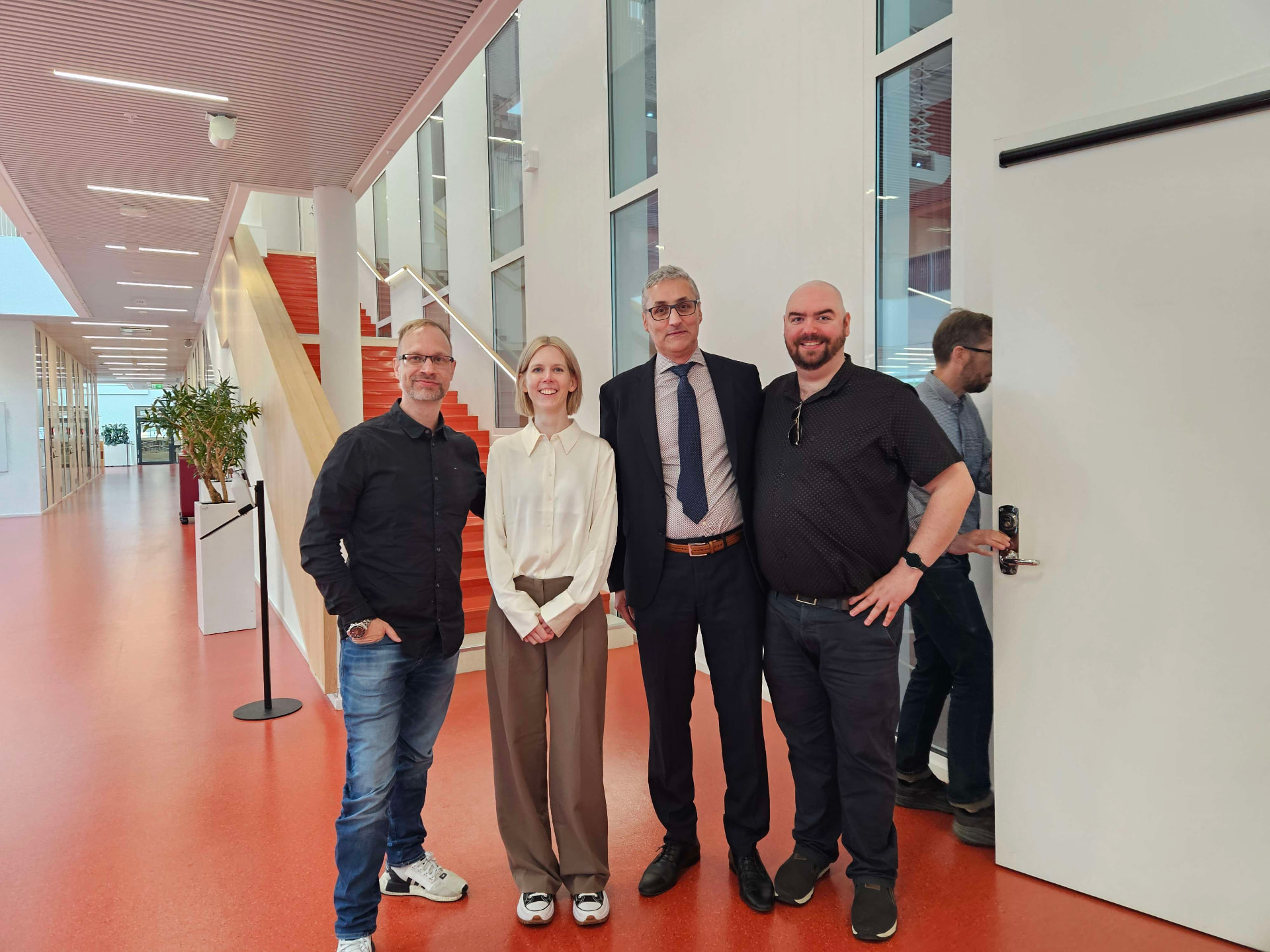
    Rickard Sörlin with thesis colleagues and examiners at Mälardalen University
    Degree project completed — Mälardalen University

    Development work

    2025 · Bachelor thesis

    2025 · Applied AI

    Selected AI, software engineering and design coursework

    Mälardalen University

    Artificial Intelligence 1 & 2 · Advanced Machine Learning · Deep Learning · Software Engineering for AI · Interaction Design

    • AI Methods
    • Machine Learning
    • Deep Learning
    • AI Lifecycle
    • User Research
    • Figma Prototyping
    • Usability Validation
    • Built a foundation in AI methods, model evaluation and software engineering for AI systems.
    • Worked through user research, ideation, Figma prototyping and usability and accessibility evaluation in interaction-design coursework.
    • Brought this technical and human-centred foundation into the later Talking SCADA concept.
  8. 2013–2020· Professional

    Support Engineer — Digital Platforms

    National Technical Expert — Sweden

    Schneider Electric

    Customer Insight · Product Lifecycle · Release Readiness

    National expert turning customers' recurring pains into product feedback, lifecycle decisions and release readiness.

    • Owned a reusable HVAC deviation-management capability — detection, alarms, logging and visualisation — turning operational data into actionable insight across customer systems.
    • Turned recurring customer issues into structured product feedback and enhancement proposals with Product Owners, Global Product Support and R&D — justified by customer impact and business value.
    • Prioritised critical issues by impact and risk, separated implementation problems from product defects, and supported release validation and controlled rollout.
    • Capability Ownership
    • Customer Insight
    • Product Feedback
    • Prioritisation
    • Release Readiness

    Selected product / platform capability

  9. 2003–2013· Professional

    Project Engineer — Digital Platforms

    Schneider Electric

    Customer Needs · Requirements · Delivery Reality

    Ten years face to face with the people who run the systems — turning their needs into working solutions and standing beside them at go-live.

    • Gathered needs from property managers, technicians, facility teams and end users, and turned them into implementation-ready designs.
    • Held technical ownership of large building-automation projects — from design through integration, testing and handover — and managed smaller projects end to end.
    • Quality-tested the IoT building-automation platform with R&D and mentored engineers in scalable, maintainable solution design.
    • Customer Needs
    • Requirements
    • Project Ownership
    • End-to-End Delivery
    • Platform Quality

Where the story continues

Each chapter has its own case study — discovery, decisions and what it changed for the people who use the result.